
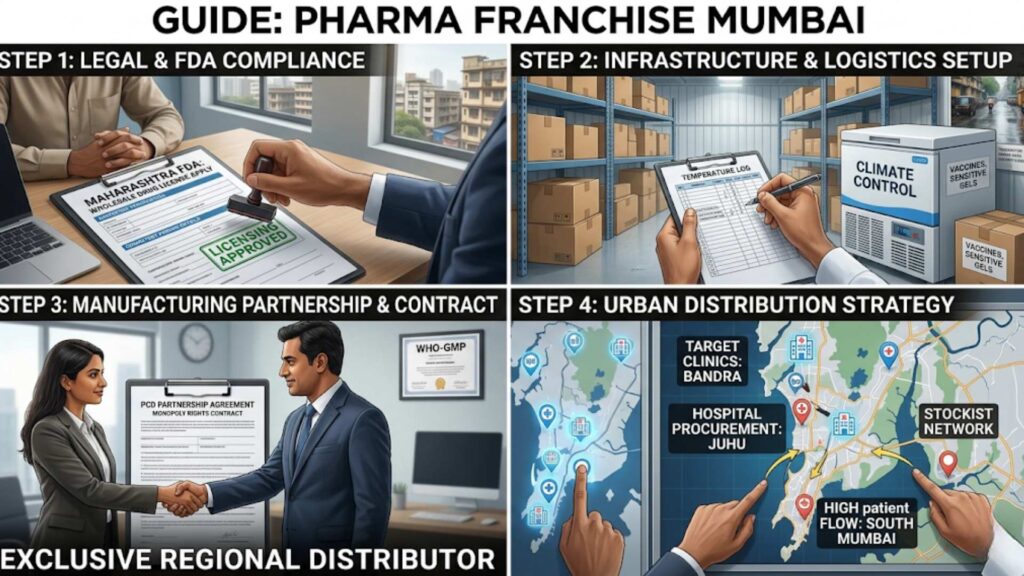
Launching a PCD Pharma Franchise in Mumbai is one of the most effective strategies to secure a profitable foothold in India’s multi-billion dollar healthcare sector. As the commercial capital, the Mumbai Metropolitan Region (MMR) features a uniquely dense concentration of premium corporate hospitals, specialized aesthetic clinics, and a highly affluent demographic demanding advanced medical care. However, navigating the bureaucratic, logistical, and competitive layers of this metropolis requires a highly structured operational roadmap.
Unlike launching a standard retail chemist shop, operating a Propaganda Cum Distribution (PCD) model allows you to act as an exclusive regional distributor for an established pharmaceutical manufacturer. This eliminates the massive financial overhead associated with setting up a factory while yielding significantly higher retail profit margins.
For entrepreneurs, medical representatives, and active wholesalers, making the transition to franchise ownership requires careful adherence to the Maharashtra Food and Drug Administration (FDA) guidelines, securing ironclad monopoly rights, and selecting a manufacturing partner that guarantees clinical efficacy. In this comprehensive step-by-step guide, we break down the exact licensing requirements, infrastructural setup, and partnership criteria needed to launch a successful pharma distribution network in Mumbai today.
Understanding the Opportunity in the Financial Capital
Before dealing with the paperwork, it is vital to understand why setting up a franchise in this specific coastal metropolis yields such high financial returns. The local healthcare dynamic heavily favors specialized and advanced medicinal distribution over simple generic volume.
Core drivers of the Mumbai pharma market:
- Unprecedented Aesthetic Demand: Extreme coastal humidity and severe urban pollution have created a booming local market for clinical dermatological treatments, barrier repair creams, and premium cosmeceuticals.
- Density of Specialist Practitioners: The region boasts thousands of highly specialized doctors—from celebrity cosmetologists to senior oncologists—who require advanced, reliable therapeutic formulations.
- Rapid Inventory Turnover: High patient volume moving through corporate hospital chains guarantees that local pharmacies restock specialized medications almost daily.
Step 1: Securing Your Legal and Regulatory Compliances
The most critical barrier to entry in the pharmaceutical supply chain is regulatory compliance. To legally receive, store, and bill medical inventory in Maharashtra, you must possess specific state-issued documentation.
Wholesale Drug License Requirements
You cannot legally distribute clinical medications without approval from the state health authorities. Applying through the Maharashtra FDA portal is mandatory.
Essential pointers for securing your drug license:
- Forms Required: You must apply via Form 20B and 21B for a standard wholesale distribution license.
- Competent Person Requirement: While you do not strictly need to be a pharmacist yourself, you must employ a Competent Person—typically a registered pharmacist or a graduate with at least one year of verified drug-handling experience.
- Documentation Needed: You must submit a clear premise layout plan, ownership or registered rent agreements, identity proofs of directors, and educational certificates of your appointed competent person.
Taxation and Business Registration
Beyond health regulations, standard corporate tax compliance is required to operate within the B2B supply chain.
Pointers for business setup:
- Corporate Structure: Register your business as a Proprietorship, LLP, or Private Limited Company to establish legal standing.
- GST Registration: An active Goods and Services Tax (GST) number is mandatory for interstate billing and claiming input tax credits when purchasing stock from your parent manufacturer.
Step 2: Securing Your Warehouse and Logistics Infrastructure
Pharmaceutical products are highly sensitive chemical compounds. The state FDA is incredibly strict regarding where and how you store your inventory before dispatching it to local Mumbai pharmacies.
Critical infrastructure requirements:
- Minimum Space Regulations: Your approved commercial premise must have a minimum carpet area of 10 to 15 square meters (as mandated by local FDA inspectors).
- Climate Control: Because Mumbai suffers from intense heat and humidity, you must install continuous air-conditioning and a pharmaceutical-grade refrigerator. This is non-negotiable for storing sensitive items like vaccines, liposomal gels, and liquid antibiotics.
- Cleanliness and Racking: The warehouse must feature proper off-the-ground shelving and adequate ventilation to prevent pest intrusion and moisture damage to cardboard packaging.
Expert Insight:
Do not rush your premise inspection. When the Maharashtra Drug Inspector visits, they are specifically looking at your temperature control setup. If you plan to distribute advanced dermatology serums or softgel capsules, lacking a proper commercial AC unit will result in an immediate rejection of your wholesale license application.
Step 3: Partnering with the Right Manufacturing Company
Once your infrastructure is legally cleared, your next step determines your long-term market survival. You must align with a parent manufacturing company that provides clinical quality and operational protection.
What to demand from your parent pharma company:
- WHO-GMP Certification: Only partner with companies that manufacture their products in sterile, positive-pressure cleanrooms. Doctors will not prescribe unverified brands.
- Exclusive Monopoly Rights: Ensure you sign a legally binding agreement granting you sole distribution rights for a specific territory (e.g., South Mumbai or Thane). This eliminates internal price wars.
- Promotional Support: The company must supply high-grade visual detailing folders, sample catch covers, MR bags, and prescription pads to assist your marketing efforts.
For example, partnering with an established national entity like Gary Pharmaceuticals ensures your new business is backed by a cGMP-certified portfolio. Their specialized clinical dermatology formulations immediately give you the high-margin, stable products required to win trust from senior Mumbai medical practitioners.
Step 4: Mapping Your Urban Distribution Strategy
A warehouse full of premium medicine is useless without a targeted distribution network. Entering the Mumbai market requires identifying the correct retail channels for your specific product catalog.
Urban Distribution Targeting Table
Medical Practitioner | Primary Product Focus | Ideal Retail Distribution Channel |
Cosmetologists & Dermatologists | Advanced serums, L-Glutathione, barrier repair gels. | Premium aesthetic clinic attached-pharmacies in affluent zones (e.g., Bandra, Juhu). |
General Physicians | Anti-infectives, pain management, basic antibiotics. | Standalone high-street chemists and massive retail pharmacy chains. |
Corporate Hospital Specialists | Heavy therapeutics, injectables, chronic care formulations. | Central hospital procurement boards and large institutional stockists. |
Trichologists | Minoxidil therapies, peptide hair serums, Biotin. | Specialized hair-transplant centers and local suburban chemists. |
The Capital Required for Immediate Launch
Starting a PCD franchise is significantly more affordable than manufacturing, but navigating a high-cost city like Mumbai requires proper financial allocation.
Estimated launch cost pointers:
- Licensing Fees: Government fees for the wholesale drug license typically range around ₹3,000, but expect additional costs for legal consultancy and premise blueprinting.
- Initial Inventory: Most premium parent companies require an initial stock order of ₹50,000 to ₹1,50,000 to grant exclusive monopoly rights.
- Working Capital: You must maintain a liquid cash buffer to cover the 30-to-45-day credit cycle typically demanded by large urban retail chemists.
Conclusion
Starting a PCD Pharma Franchise in Mumbai provides a highly secure, high-yield entry into India’s most robust healthcare market. While the regulatory process—including securing an FDA wholesale drug license and preparing a climate-controlled warehouse—requires strict attention to detail, it is a proven pathway to massive profitability. By carefully selecting a WHO-GMP certified manufacturing partner that offers exclusive territorial monopoly rights, you can bypass heavy industrial overhead and focus entirely on building lucrative relationships with top-tier urban doctors. Follow these specific steps, secure your working capital, and you will be well on your way to building a permanent pharmaceutical footprint in the commercial capital.