
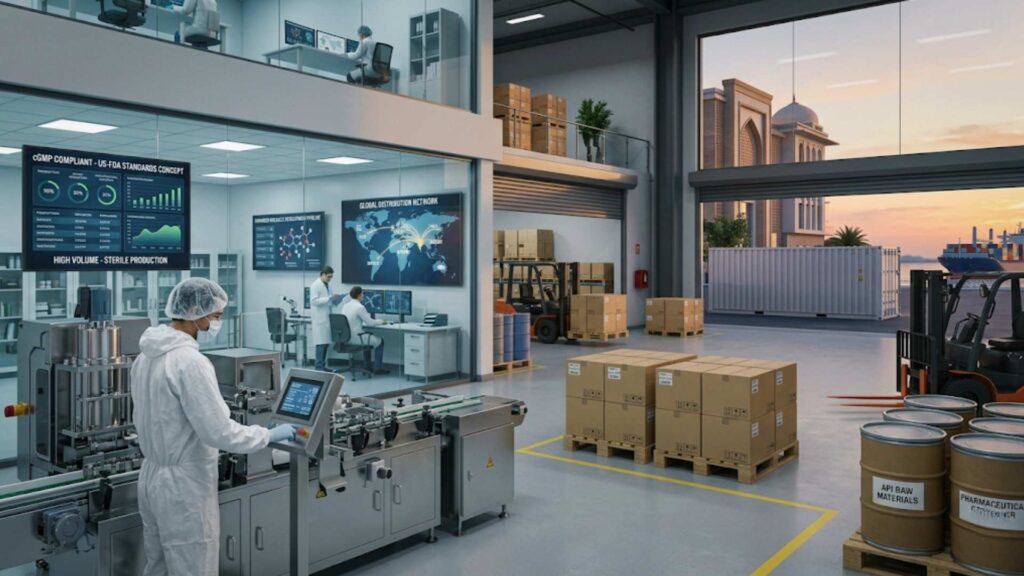
The global healthcare supply chain has undergone a massive restructuring over the last five years, definitively establishing a localized pharma hub in india as the most critical node in international medicine. With a domestic market valuation reaching USD 60 billion in 2026 and aggressive projections scaling toward USD 130 billion by 2030, the nation is no longer just a low-cost outsourcing destination. It has evolved into a highly sophisticated epicenter for advanced research, complex clinical formulations, and massive global exports.
Historically known as the Pharmacy of the World due to its dominance in generic medicines, India is currently undergoing a strategic transformation. Rather than relying solely on volume-driven output, top-tier manufacturers are pivoting heavily toward value-driven innovations, including complex biologics, precision oncology therapies, and premium dermatological formulations. This shift is attracting unprecedented foreign direct investment and cementing the country’s status as an irreplaceable pillar of global healthcare security.
For pharmaceutical distributors, regional PCD franchise owners, and international healthcare brands, understanding this macro-economic shift is essential for securing long-term supply chain stability. In this comprehensive analysis, we explore the exact regulatory, infrastructural, and scientific drivers that are catapulting India to the absolute forefront of the global pharmaceutical industry.
The Macro-Economic Shift Toward the Subcontinent
India’s ascent in the global pharmaceutical hierarchy is backed by undeniable data. The country currently ranks third globally by volume and supplies roughly 20 percent of the world’s total demand for generic drugs, exporting to over 190 countries.
Key macroeconomic pointers driving this expansion:
- Unprecedented Export Growth: In the 2025-2026 fiscal cycle, pharmaceutical exports surpassed USD 30 billion, with over 50 percent of these shipments directed to highly regulated markets like the United States and Europe.
- Massive Manufacturing Footprint: The country boasts over 10,500 active manufacturing units and over 3,000 corporate pharmaceutical entities driving continuous output.
- Government PLI Schemes: The Production Linked Incentive (PLI) scheme has injected billions of rupees into the sector to boost domestic manufacturing and product diversification.
Core Drivers Accelerating India’s Pharmaceutical Dominance
The transition from a developing market to a global pharmaceutical superpower requires deep structural advantages. India leverages three specific pillars to maintain its competitive edge.
World-Class Manufacturing and US-FDA Compliance
Global medical trust is built entirely on manufacturing compliance. India has aggressively upgraded its factory floors to meet the strictest international benchmarks.
Manufacturing excellence pointers:
- Global Compliance Leadership: India holds the highest number of US-FDA registered manufacturing sites (over 1,000 facilities) outside of the United States.
- WHO-GMP Certified Infrastructure: Domestic companies operate vast networks of WHO-GMP certified cleanrooms equipped with positive pressure and HEPA filtration to ensure sterile, zero-defect production.
- Agile Scaling: Indian factories possess the unique operational agility to seamlessly scale production from small batches of orphan drugs to massive, multi-million unit runs of essential pharma products.
The Transition to High-Value Biologics and Biosimilars
While traditional small-molecule drugs continue to generate massive revenue, the fastest-growing sector is undeniably large-molecule therapeutics.
Biologics expansion pointers:
- Biosimilar Pipeline: With the global biosimilar market expanding rapidly, Indian firms are capturing massive market share in affordable oncology and immunology treatments.
- Government Support: Initiatives like the Biopharma SHAKTI program are injecting ₹10,000 crore to establish India as a global biopharmaceutical manufacturing epicenter.
- Gene and Cell Therapy Integration: Advanced R&D clusters in cities like Hyderabad and Bengaluru are shifting focus toward highly personalized medicine.
Securing the Supply Chain with Domestic APIs
Historically, the global pharmaceutical industry was highly vulnerable to external supply chain shocks due to a heavy reliance on a single geographic region for raw materials. India is actively correcting this imbalance.
Supply chain security pointers:
- Domestic API Parks: The government has allocated massive funding to establish Mega Bulk Drug Parks to produce critical active pharmaceutical ingredients (APIs) locally.
- Reduced Import Dependency: By synthesizing complex chemical intermediaries domestically, India ensures uninterrupted production cycles even during global geopolitical disruptions.
- Cost Efficiency Control: Controlling the raw material source allows Indian manufacturers to maintain the aggressive pricing models that dominate the global generics market.
Expert Insight:
The true strength of the Indian pharmaceutical industry in 2026 is no longer just affordability; it is supply chain resilience and clinical quality. With the deepest bench of US-FDA approved facilities in the world, India provides the global healthcare system with an unbreakable guarantee of scale, safety, and continuous delivery.
Analyzing India’s Pharmaceutical Export Footprint
To visualize how India controls the global medical supply, we must categorize its output based on clinical applications and regional targeting.
Global Pharmaceutical Export and Supply Chain Table
Pharmaceutical Segment | Global Market Contribution | Core Formulations | Key Target Markets |
Generic Medicines | Supplies 40% of US generics and 25% of UK generics. | Cardiovascular, Anti-diabetics, Anti-infectives. | United States, European Union, Canada, Australia. |
Global Vaccines | Supplies 60% to 70% of the world’s WHO vaccine requirements. | DPT, BCG, Measles, and specialized immunizations. | Africa, South America, Southeast Asia, UNICEF programs. |
Complex Biologics | Rapidly capturing market share in affordable targeted therapies. | Monoclonal antibodies, Biosimilar insulins. | Europe, Middle East, emerging Latin American markets. |
Advanced Cosmeceuticals | High-margin aesthetic and clinical skin treatments. | Encapsulated retinoids, L-Glutathione, Clobetasol. | UAE, Southeast Asia, CIS nations, domestic Indian metros. |
How Global Brands and Regional Franchisees Benefit
This massive industrial expansion directly benefits distribution partners operating at the grassroots level. Regional PCD pharma franchisees in India now have access to the exact same world-class formulations that are exported to stringent US and EU markets.
For example, established domestic leaders like Gary Pharmaceuticals leverage this advanced national infrastructure to produce clinical-grade dermatology products. By operating cGMP-certified facilities within this thriving ecosystem, they provide their franchise partners with highly stable, premium-packaged therapeutic and cosmeceutical lines that build instant credibility with prescribing dermatologists.
The Future of the Subcontinent’s Healthcare Leadership
India’s strategy for the next decade is clear: transition entirely from volume-driven output to value-driven clinical innovation. The continuous integration of Artificial Intelligence in drug discovery, the expansion of continuous manufacturing assembly lines, and the deep domestic synthesis of APIs guarantee that India will remain the undisputed backbone of international healthcare for decades to come.
Conclusion
India’s rapid evolution into the ultimate global pharmaceutical hub is the result of decades of strategic infrastructure investment, rigorous international compliance, and a highly skilled scientific workforce. By dominating the global supply of generic medicines, scaling up the production of complex biologics, and securing the raw API supply chain, the nation has established unparalleled healthcare resilience. For international brands and domestic franchise operators, aligning with this powerhouse ecosystem guarantees access to safe, highly effective, and cutting-edge medical formulations. As the global demand for precision medicine and affordable therapeutics surges, India stands ready to deliver at a scale no other nation can match.