
When launching a specialized skincare brand or expanding a pharmaceutical distribution network, choosing high-quality dermatology products is the most critical factor for long-term commercial success. The skin is the body’s largest organ, capable of absorbing up to 60 percent of topically applied substances. When treating chronic conditions like severe eczema, psoriasis, or compromised dermal barriers, applying a substandard formulation can lead to systemic toxicity, treatment failure, or severe site irritation.
Navigating this therapeutic landscape requires absolute production precision. Unlike basic cosmetics, medical-grade formulations require precise microstructural engineering to ensure active ingredients penetrate the stratum corneum effectively. This is where manufacturing standards separate reliable brands from low-tier alternatives.
For pharmaceutical franchise owners and prescribing doctors, partnering with a source that is explicitly WHO-GMP certified eliminates the risks associated with batch-to-batch inconsistency. The World Health Organization’s Good Manufacturing Practices represent the most rigorous global benchmark for quality assurance, dictating an uncompromising approach to topical semi-solids like creams, gels, and ointments.
The Critical Role of Quality Assurance in Dermal Applications
Topical formulations face unique biochemical challenges that oral tablets do not. An emulsion can separate, a highly concentrated active pharmaceutical ingredient (API) can crystalize, and a water-based gel can easily become a breeding ground for bacteria if not preserved correctly.
Strict quality assurance ensures that a manufacturer operates under a rigid Quality Management System (QMS) designed to identify and eliminate these risks before the product reaches the pharmacy shelf. This is achieved through a framework known as Quality by Design (QbD), where product quality is built directly into the manufacturing process rather than just tested at the very end.
Why topical therapies demand heightened compliance:
- Compromised Skin Barriers: Patients with dermatitis or open lesions absorb APIs at a highly accelerated rate, making exact dosage calibration critical.
- API Degradation: Sensitive ingredients like Vitamin C, Retinoids, and certain peptides degrade rapidly without precise formulation and temperature-controlled processing.
- Cross-Contamination Risks: Manufacturing potent corticosteroids and immunosuppressants in the same facility requires advanced isolation protocols to prevent microscopic cross-contamination.
Core Quality Parameters in Dermatological Manufacturing
To maintain verified certification status, a manufacturing facility must continuously execute complex analytical tests to prove their formulations are stable, safe, and effective.
Formulation Consistency: Q1, Q2, and Q3 Standards
In topical drug development, equivalence is measured across three strict parameters:
- Q1 (Qualitative): The formulation must contain the exact same active and inactive ingredients.
- Q2 (Quantitative): The formulation must contain the exact same concentration of those ingredients.
- Q3 (Microstructural): This is the most complex parameter. The formulation must possess the exact same physical arrangement, micro-structure, and drug state.
Even if a generic cream has the correct API and excipients, if the mixing process alters the microstructure (Q3), the drug will not release into the skin properly. Global quality guidelines mandate strict controls over mixing speeds, cooling rates, and homogenization to ensure Q3 consistency across every single batch.
In Vitro Release and Permeation Testing (IVRT & IVPT)
To prove that a semi-solid formulation works, manufacturers utilize advanced diffusion testing.
- IVRT (In Vitro Release Testing): Uses a synthetic membrane in a Franz diffusion cell to measure the exact rate at which the API is released from the cream or gel base. This confirms batch-to-batch consistency.
- IVPT (In Vitro Permeation Testing): Utilizes excised skin models to measure how deeply and quickly the drug penetrates the dermal layers.
Microbial Limits and Preservative Efficacy
Water-based topical products (creams and lotions) are highly susceptible to microbial growth. Compliance mandates rigorous Total Aerobic Microbial Count (TAMC) and Total Yeast and Mold Count (TYMC) testing. Furthermore, Preservative Effectiveness Testing (PET) is conducted to ensure the product’s antimicrobial system will withstand repeated use by the patient over its intended shelf life.
Expert Insight:
In topical formulations, having the right active ingredient is only half the battle. If a generic cream fails to match the microphysical structure (Q3) of the reference drug, its skin permeation profile will drop dramatically. Stringent quality systems mandate strict rheological and stability controls to prevent this exact failure.
Advanced Facility Standards for Global Compliance
Achieving elite manufacturing status requires a massive investment in physical infrastructure. You cannot manufacture high-grade clinical items in a standard warehouse facility.
Key facility requirements include:
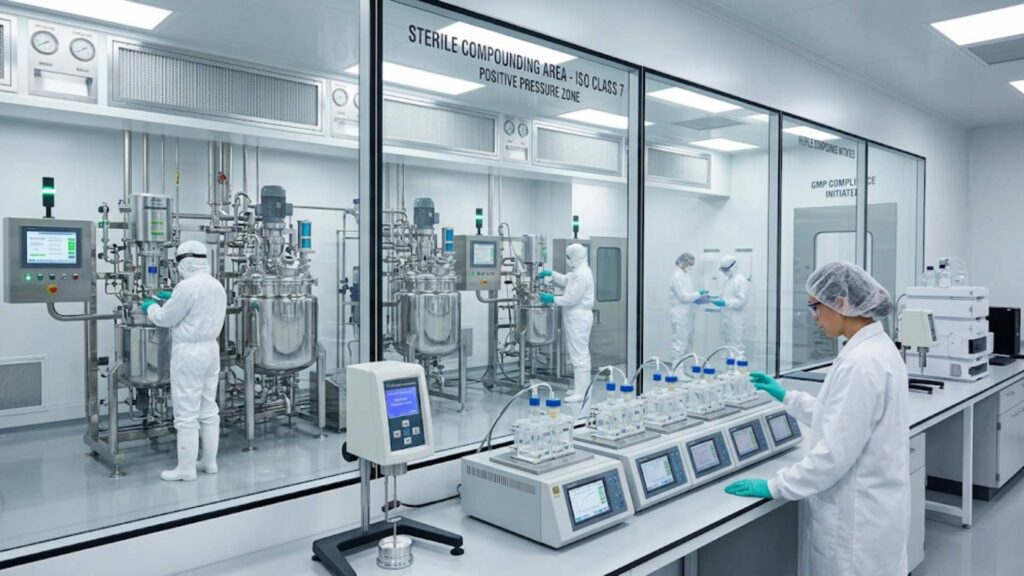
- Classified Clean Rooms: Manufacturing zones must be equipped with high-efficiency particulate air (HEPA) filters to maintain strict limits on airborne particles.
- Positive Air Pressure Systems: Corridors and airlocks are pressurized to ensure that outside air (and potential contaminants) cannot flow into sterile compounding rooms.
- Automated CIP Systems: Clean-in-Place (CIP) technology is utilized to sanitize giant mixing vessels automatically, preventing human error and eliminating the risk of residue carrying over between different product batches.
Quality Control Metrics for Semi-Solid Formulations
To understand how rigorous the quality assurance process is, we must look at the specific physical attributes tested on the factory floor. Each of these parameters directly impacts how the product will perform on a patient’s skin.
Topical Formulation Quality Control Table
Quality Attribute | Testing Methodology | Clinical Impact on Patient |
Rheology & Viscosity | Rotational viscometry | Determines the product’s spreadability, patient compliance, and localized retention on the target skin site. |
Microstructural Homogeneity | Particle size analysis & microscopy | Prevents a gritty texture, ensures uniform API distribution, and directly influences the absorption rate. |
Phase Stability | Centrifugation & accelerated thermal cycling | Prevents emulsion separation (cracking), ensuring the active ingredients do not pool at the bottom of the tube. |
pH Compatibility | Potentiometric titration | Ensures the formulation matches the skin’s natural acid mantle, preventing chemical irritation and API degradation. |
Assay Uniformity | High-Performance Liquid Chromatography (HPLC) | Guarantees that every single gram squeezed from the tube contains the exact prescribed dose of the therapeutic agent. |
Why Franchises and Dermatologists Rely on Certified Manufacturers
When a medical representative details a product to a senior dermatologist, the first question often revolves around the manufacturing source. Doctors are inherently risk-averse; they will not prescribe a highly potent topical steroid or an advanced anti-fungal if they doubt the manufacturer’s quality control infrastructure.
For product distributors, sourcing inventory from a certified plant provides an immediate shield of credibility. It guarantees that the supply chain will not be interrupted by failed stability tests or sudden regulatory recalls. More importantly, it ensures that the products deliver the promised clinical results, leading to satisfied patients and consistent repeat prescriptions
Conclusion
World-class certification is the definitive benchmark for quality assurance in the pharmaceutical sector. In the highly complex field of dermatology, where product efficacy relies heavily on formulation microstructures and skin permeation rates, these protocols are absolutely vital. By enforcing strict facility standards, mandating comprehensive IVRT/IVPT analyses, and requiring rigorous stability testing, global guidelines ensure that every topical treatment is safe, potent, and clinically reliable. For anyone operating in the dermatology space, aligning with certified manufacturing standards is the foundation of long-term commercial and clinical success.