
Dealing with severe, infected skin conditions requires highly specialized medication, and clobetasol propionate and fusidic acid cream represents one of the most potent dual-action therapies available. Prescribed strictly for acute inflammatory skin conditions that have become complicated by secondary bacterial skin infections, this formulation provides rapid symptomatic relief. However, because it contains an ultra-high potency steroid, it is not meant for casual or long-term cosmetic use.
Using this cream without understanding its biochemical impact can lead to severe localized tissue damage or systemic complications. Patients and caregivers must be fully educated on where to apply it, how much to use, and when to stop.
In this clinical guide, we break down the critical precautions, potential side effects, and exact application guidelines you need to know before initiating treatment with this powerful pharmaceutical formulation.
The Clinical Power of Dual-Action Topical Therapies
Treating a severely inflamed, infected wound requires addressing two separate biological issues simultaneously.
Why dual-action therapies are prescribed:
- Inflammation Control: The immune system overreacts, causing severe swelling, redness, and unbearable itching (pruritus).
- Bacterial Eradication: Broken skin barriers allow pathogens (like Staphylococcus aureus) to enter and multiply, creating pustules and preventing natural healing.
- Synergistic Healing: By combining a potent steroid to suppress the immune reaction and an antibiotic to kill the bacteria, the cream rapidly closes the infection window and repairs the dermal barrier.
Understanding the Active Ingredients
To understand the precautions, you must first understand exactly how these two distinct active pharmaceutical ingredients function on a cellular level.
The Role of Clobetasol Propionate
Clobetasol propionate is classified as a super-high potency (Class I) topical corticosteroid.
Key pointers regarding Clobetasol:
- Extreme Potency: It is significantly stronger than over-the-counter hydrocortisone, meaning it acts incredibly fast to suppress severe inflammation.
- Vasoconstriction: It works by constricting blood vessels in the skin, instantly reducing redness and localized swelling.
- Usage Limits: Because of its sheer strength, its use is typically strictly capped at a maximum of two consecutive weeks to prevent tissue degradation.
The Role of Fusidic Acid
Fusidic acid is a highly effective topical antibiotic specifically formulated for dermatological use.
Key pointers regarding Fusidic Acid:
- Targeted Action: It is exceptionally effective against Gram-positive bacteria, particularly the staphylococcal strains that most commonly infect human skin.
- Protein Synthesis Inhibition: It works by penetrating the bacterial cell wall and preventing the pathogen from producing the proteins it needs to multiply.
- Resistance Risks: Like all antibiotics, prolonged or improper use can lead to bacterial resistance, rendering the cream ineffective for future infections.
Critical Precautions Before Application
Before unscrewing the cap on this medication, patients must adhere to strict medical boundaries to prevent accidental harm.
Crucial safety precautions:
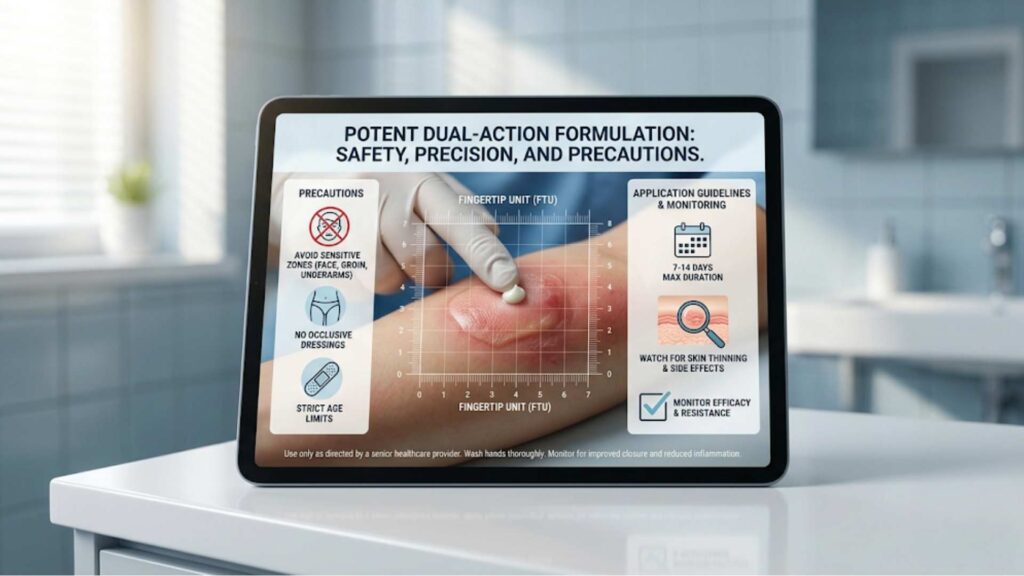
- Facial Application Ban: Never apply this cream to the face unless explicitly directed by a senior dermatologist. It can cause permanent skin thinning, rosacea, and perioral dermatitis.
- Avoid Sensitive Zones: Do not apply to the groin, underarms (axillae), or any mucosal membranes (eyes, inside the nose, or mouth), as these areas absorb steroids at dangerously high rates.
- No Occlusive Dressings: Do not cover the treated area with airtight bandages, plastic wraps, or tight clothing unless instructed by a doctor. Occlusion forces the steroid into the bloodstream, triggering systemic side effects.
- Pregnancy and Nursing: Always consult a physician before use if pregnant or breastfeeding, as high-potency steroids can cross the placental barrier or enter breast milk.
- Age Restrictions: This formulation is generally contraindicated for infants and young children, whose high surface-area-to-body-mass ratio makes them highly susceptible to systemic steroid toxicity.
Potential Side Effects and Adverse Reactions
While highly effective, this combination cream carries a profile of potential side effects ranging from mild local irritation to severe systemic issues.
Common and rare side effects to monitor:
- Skin Atrophy (Thinning): The most common risk of prolonged use. The skin becomes paper-thin, fragile, and prone to easy bruising or tearing.
- Striae (Stretch Marks): Rapid degradation of dermal collagen can cause permanent stretch marks at the application site.
- Telangiectasia: Visible, permanently dilated blood vessels (spider veins) may appear on the skin’s surface.
- Contact Dermatitis: Some patients may develop an allergic reaction to the fusidic acid or the cream’s preservative base, resulting in worsened redness and stinging.
- Adrenal Suppression: In extremely rare cases of massive over-application, the steroid can enter the bloodstream and suppress the body’s natural adrenal gland function, a serious medical emergency.
Expert Insight:
The most common clinical error I see with super-potent steroids like clobetasol is patient drift. A patient uses the cream for a severe eczema flare-up, it works brilliantly, so they keep it in their cabinet and start using it months later as a daily moisturizer for minor rashes. This inevitably leads to severe skin atrophy and topical steroid withdrawal.
Safety and Efficacy Monitoring Table
To help patients track their physiological response to the medication, use the following monitoring criteria.
Side Effect Identification and Action Table
Symptom / Reaction | Clinical Classification | Recommended Patient Action |
Mild stinging upon application | Normal / Mild | Continue treatment; usually subsides within minutes. |
Increased redness or swelling | Suspected Allergic Reaction | Stop application immediately and consult a dermatologist. |
Skin looking translucent or papery | Skin Atrophy (Steroid Damage) | Cease use immediately; you have likely exceeded the safe treatment duration. |
Lack of improvement after 7 days | Treatment Failure / Resistance | Consult your doctor; a different antibiotic class may be required. |
Application Guidelines for Maximum Safety
Achieving clinical resolution without triggering adverse effects relies entirely on precise dosing and strict adherence to timelines.
Step-by-step application pointers:
- Wash and Dry: Gently clean the infected area with a mild, soap-free cleanser and pat it completely dry before application.
- Fingertip Unit (FTU) Dosing: Use the exact amount prescribed. A fingertip unit (a line of cream from the tip of an adult index finger to the first crease) is enough to cover an area roughly the size of two adult palms.
- Thin Layer Application: Massage a very thin layer gently into the affected lesion until it disappears. Do not slather it on thickly.
- Wash Hands Immediately: Unless treating an infection on your hands, wash your fingers thoroughly with soap to prevent transferring the potent steroid to your face or eyes.
- Strict Timeline Tracking: Mark your calendar. Never exceed the prescribed duration—typically 7 to 14 days maximum.
Conclusion
Clobetasol propionate and fusidic acid cream is an exceptionally powerful therapeutic tool designed to conquer severe, infected dermatological conditions quickly. However, its immense strength requires deep respect for clinical boundaries. By understanding the risks of skin thinning, strictly avoiding sensitive areas like the face and groin, and limiting usage to the briefest possible window, patients can safely eradicate bacterial infections and halt severe inflammation. Always use this medication under the direct supervision of a licensed healthcare provider, and never repurpose leftover cream for minor everyday skin irritations.