
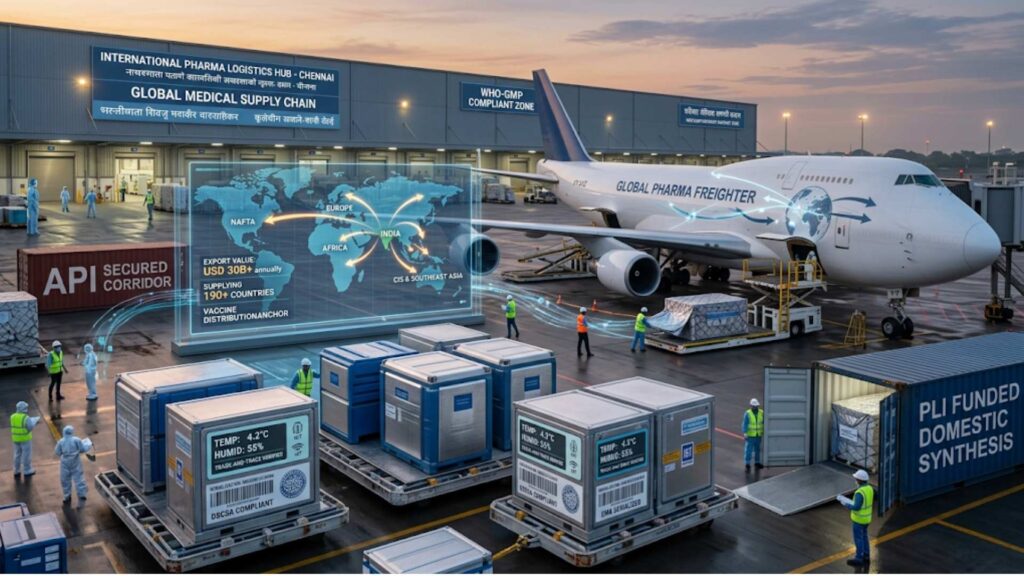
The international healthcare ecosystem is currently undergoing a massive structural transformation, and the global distribution of high-grade pharma products from India is at the absolute center of this shift. As of 2026, the Indian pharmaceutical sector is valued at a staggering USD 60 billion, functioning no longer just as a low-cost outsourcing destination, but as the primary medical lifeline for over 190 countries. From exporting highly complex biosimilars to the United States to supplying over 60 percent of the world’s essential vaccines through UNICEF, the scale of this physical distribution network is unprecedented.
However, moving a sensitive, life-saving chemical compound from a manufacturing plant in Maharashtra to a hospital pharmacy in Europe or South America is a logistical gauntlet. It requires navigating overlapping geopolitical trade routes, maintaining exact thermal thresholds, and complying with the most rigorous regulatory documentation in global commerce.
For pharmaceutical distributors, international sourcing agents, and regional franchise owners, understanding this cross-border infrastructure is critical to maintaining a resilient business. In this deep dive, we break down the specific manufacturing protocols, cold-chain logistics, and digital compliance systems that enable India to flawlessly execute over USD 30 billion in pharmaceutical exports annually.
The Evolution of India’s Export Infrastructure
India’s transition into an advanced global medical supplier required a total overhaul of its shipping, data management, and warehousing infrastructure. The focus has shifted from merely reducing transit costs to guaranteeing absolute product integrity regardless of global supply chain disruptions.
Core advancements in the export supply chain:
- Digital Integration: Logistics providers have adopted real-time, AI-driven visibility systems, allowing both the manufacturer and the foreign buyer to track cargo movement across every international node.
- Specialized Cargo Hubs: Major international airports (such as Mumbai and Hyderabad) have built dedicated, climate-controlled pharma-zones specifically designed to handle massive volumes of biologicals and sensitive vaccines.
- Agile Sourcing Corridors: Manufacturers are utilizing advanced predictive models to foresee global port congestion, rerouting shipments dynamically to ensure uninterrupted fulfillment to foreign hospital networks.
Manufacturing Standards Driving Global Acceptance
You cannot export medicine to highly regulated global markets without first proving that the product is perfectly safe, sterile, and consistent. The foundation of the Indian export boom is rooted entirely in manufacturing compliance.
Leveraging WHO-GMP Certified Facilities
Before a drug can cross an international border, the facility producing it must meet stringent international audits.
How top-tier facilities maintain export readiness:
- Uncompromising Sterility: Elite manufacturers operate WHO-GMP certified cleanrooms featuring positive air pressure and advanced HEPA filtration to eliminate any microscopic cross-contamination.
- Quality by Design (QbD): Regulatory bodies require manufacturers to build quality checks directly into the formulation process, rather than relying solely on end-of-batch testing.
- Corporate Consistency: Established domestic leaders like Gary Pharmaceuticals utilize these rigorous cGMP-certified frameworks. By ensuring strict formulation stability and advanced packaging, they produce clinical-grade dermatology and therapeutic products capable of withstanding the rigors of global transit and international climate variations.
Navigating International Track-and-Trace Compliance
Global counterfeit medicine is a multi-billion dollar threat. To combat this, regulated international markets have implemented aggressive digital tracking mandates.
Pointers on modern export compliance:
- Serialization Mandates: Every single unit of medicine exported from India must feature a globally recognized, unique barcode identifier to trace its exact origin.
- Blockchain Verification: Advanced exporters are utilizing blockchain ledgers to create immutable records of custody transfers, proving to foreign regulators that the cargo was never tampered with.
- Regulatory Synchronization: Exporters must continuously adapt their packaging data to align with stringent rules like the EU’s Falsified Medicines Directive and the US Drug Supply Chain Security Act (DSCSA).
Expert Insight:
In 2026, international supply chain success is no longer defined by how fast a product moves from Mumbai to London, but by how flawlessly the compliance data moves with it. If a million-dollar shipment of oncology drugs arrives at a European port with a single track-and-trace data mismatch, the entire batch is quarantined. Data standardization is now as critical as the formulation itself.
Overcoming Logistical Complexities in the Supply Chain
Physical transit remains the highest-risk phase of the international pharmaceutical lifecycle. Managing these risks requires highly specialized logistics partnerships.
Advanced Cold Chain and Temperature Control
A massive percentage of modern pharmaceuticals—including vaccines, insulin, and specialized cosmeceutical serums—are biologically active and rapidly degrade if exposed to temperature fluctuations.
Innovations in temperature-controlled freight:
- Phase-Change Materials: Advanced packaging utilizes chemical coolants that maintain exact internal temperatures for up to 120 hours without requiring active refrigeration.
- IoT Sensor Integration: Real-time Internet of Things (IoT) data loggers are placed inside pallets, instantly alerting logistics teams via satellite if the cargo’s temperature deviates by even a single degree.
- Tarmac Protection: Airlines and ground handlers now use specialized thermal blankets to protect sensitive cargo from extreme heat spikes while sitting on airport tarmacs waiting for loading.
Securing Active Pharmaceutical Ingredients (APIs)
India cannot export finished medications if it cannot source the raw materials to build them. Over the last few years, the country has heavily restructured its inbound supply chain.
Strategies securing raw material continuity:
- Domestic Synthesis Expansion: Massive government-backed Production Linked Incentive (PLI) schemes are successfully funding the domestic manufacturing of active pharmaceutical ingredients (APIs) to reduce reliance on single-nation imports.
- Multi-Sourcing Protocols: To buffer against global geopolitical disruptions, major manufacturers now qualify at least three geographically distinct suppliers for every critical raw material.
- Strategic Stockpiling: The industry has moved away from hyper-lean just-in-time manufacturing, choosing instead to hold larger safety stocks of essential KSMs (Key Starting Materials) to guarantee uninterrupted global fulfillment.
Mapping the Indian Pharmaceutical Export Footprint
India’s export strategy is highly diversified. To understand the scale of this distribution, we must categorize the primary markets receiving Indian therapeutics.
Global Export Allocation and Market Strategy Table
International Region | Estimated Export Share | Dominant Product Categories Shipped | Primary Regulatory Hurdle |
NAFTA (USA & Canada) | ~35% – 37% | Complex generics, biosimilars, and chronic care therapeutics. | Extremely high compliance strictness (US-FDA, DSCSA). |
Europe | ~18% – 20% | High-value biologics, precision oncology, and specialty injectables. | Rigorous serialization and EMA environmental audits. |
Africa | ~12% – 15% | Massive volumes of essential vaccines, anti-retrovirals, and anti-infectives. | Highly fragmented regional logistics and varying customs rules. |
CIS & Southeast Asia | ~10% – 12% | Dermatology treatments, premium cosmeceuticals, and metabolic care. | Rapidly evolving localized pricing and labeling mandates. |
The Strategic Future of Global Medicine Distribution
As the demand for accessible, high-quality healthcare continues to surge globally, the pathways connecting Indian manufacturers to international patients will only become more integrated. By mastering complex cold-chain logistics, achieving total digital traceability, and ensuring unbroken compliance with global regulatory bodies, India is solidifying its position as the anchor of world medicine. For domestic manufacturers, B2B sourcing agents, and international healthcare brands, establishing deep ties with this highly resilient, WHO-GMP certified export ecosystem is the ultimate guarantee of long-term commercial and clinical stability.
Conclusion
The journey of pharmaceutical products from an Indian manufacturing plant to a global consumer is an extraordinary feat of scientific compliance and logistical engineering. The nation’s ability to seamlessly export over USD 30 billion worth of life-saving therapeutics relies on an unyielding commitment to WHO-GMP standards, advanced digital track-and-trace implementation, and highly resilient cold-chain networks. By actively securing the domestic supply of raw active pharmaceutical ingredients and aligning with the strictest US and EU regulations, India has completely bulletproofed its international supply chain. For global buyers and regional distribution franchises, this infrastructure ensures that every shipped formulation delivers maximum clinical efficacy, no matter where in the world the patient resides.